
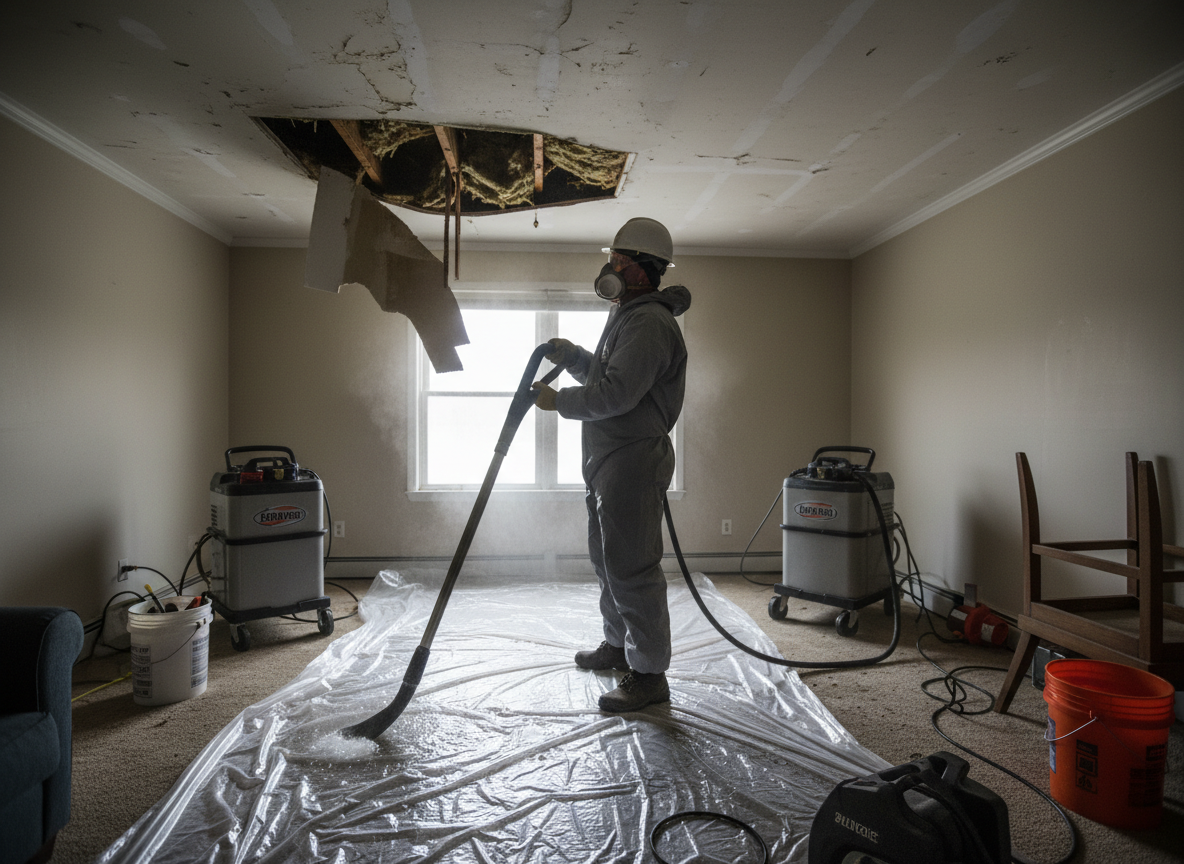
In Maricopa County’s hot desert climate, summer expansion and contraction plus monsoon downpours frequently open seams on concrete tile roofs common in Vistancia and older neighborhoods around Old Town Peoria. Water travels along rafters and pools in attics before surfacing through ceilings, often reaching drywall and insulation within hours. Extraction must begin before mold sets in on the OSB sheathing that many 1990s–2000s homes here still carry.
We pull standing water with truck-mounted vacuums, then place air movers and dehumidifiers sized for the tight attic cavities found in Peoria’s single-story ranch homes. Hidden saturation behind stucco returns or in knee-wall insulation is mapped with moisture meters so we do not leave damp pockets that later cause drywall failure. Because summers routinely exceed 110 °F, equipment is staged to avoid overheating while still achieving 40–50 % relative humidity targets.
After extraction we remove saturated insulation and affected drywall sections, bag the debris on-site, and treat exposed framing with an EPA-registered antimicrobial. Final clearance readings are taken at multiple joist depths before any reconstruction begins. Homeowners in Surprise and Glendale frequently call after the first heavy monsoon because their homes share the same roof profiles and construction era as Peoria stock.
Lake Pleasant Regional Park and Rio Vista Park areas see additional wind-driven rain that forces water under ridge vents and skylights; we carry extra extraction wands for these elevated or angled roof planes. All work is scheduled around the business hours posted at our 7380 W Olive Ave location so residents know when crews will arrive and depart.
Technician insight
In Peoria the thing that catches most people out with roof leak water damage restoration is how quickly monsoon water travels along the paper-faced OSB sheathing used in 1990s Vistancia and Old Town homes; once it reaches the top plate it soaks the drywall from the back and homeowners only notice when the ceiling stains appear days later.
Vistancia Tile Roof Leak After Monsoon
Heavy monsoon rain entered under lifted tiles on a 2004 Vistancia home and pooled above the master bedroom. Extraction removed several gallons from the attic, saturated batt insulation was cut out, and directed drying brought moisture readings below 12 % within 48 hours so new drywall could be hung without delay.
Roof Leak Water Damage Restoration Services We Offer
✓Attic Water Extraction
Removes pooled water from attic cavities before it migrates into living spaces, using low-profile wands that fit between trusses common in Peoria homes.
✓Ceiling Cavity Drying
Places directed air movers and dehumidifiers above ceilings to pull moisture from drywall and insulation without full demolition when readings allow.
✓Saturated Insulation Removal
Cuts out and bags wet fiberglass or cellulose insulation that holds water for weeks in desert attics, preventing hidden mold growth.
✓Monsoon Roof Leak Response
Provides same-day extraction and drying after heavy monsoon rains that overwhelm older tile roofs in Old Town Peoria and Vistancia.
✓Drywall Moisture Mapping
Uses pin and pinless meters to locate the full extent of water migration behind walls and ceilings so repairs address every affected area.
Roof Leak Water Damage Restoration Cost in Peoria, AZ
| Service | Typical Range | What Affects It |
|---|---|---|
| Attic Water Extraction | $350–$750 | Varies with water volume and roof pitch access in single-story homes. |
| Ceiling Cavity Drying | $400–$900 | Includes equipment runtime; longer in thick insulation common in 1990s builds. |
| Saturated Insulation Removal | $250–$600 | Per room; higher when multiple layers or cathedral ceilings are present. |
| Full Room Moisture Mapping & Treatment | $200–$450 | Covers meter readings and antimicrobial application. |
Ranges are typical for Peoria, AZ and confirmed with an exact written quote before any work starts.
How it works
- 1
On-Site Assessment
Technician inspects roof leak entry points, measures moisture in attic and ceiling materials, and identifies affected zones in homes across Old Town Peoria or Vistancia.
- 2
Water Extraction
Truck-mounted equipment removes standing water from attics and cavities, followed by placement of drying equipment sized for desert heat loads.
- 3
Material Removal & Antimicrobial Treatment
Saturated drywall and insulation are removed, framing is treated, and debris is bagged for disposal before drying continues.
- 4
Final Moisture Verification
Multiple readings confirm dryness at joist and sheathing depths; only then is the job released for reconstruction.
Pricing
Upfront quotes given after inspection; final price depends on volume of water, number of affected rooms, and access constraints.